How Logistics Software Improves Supply Chain Efficiency

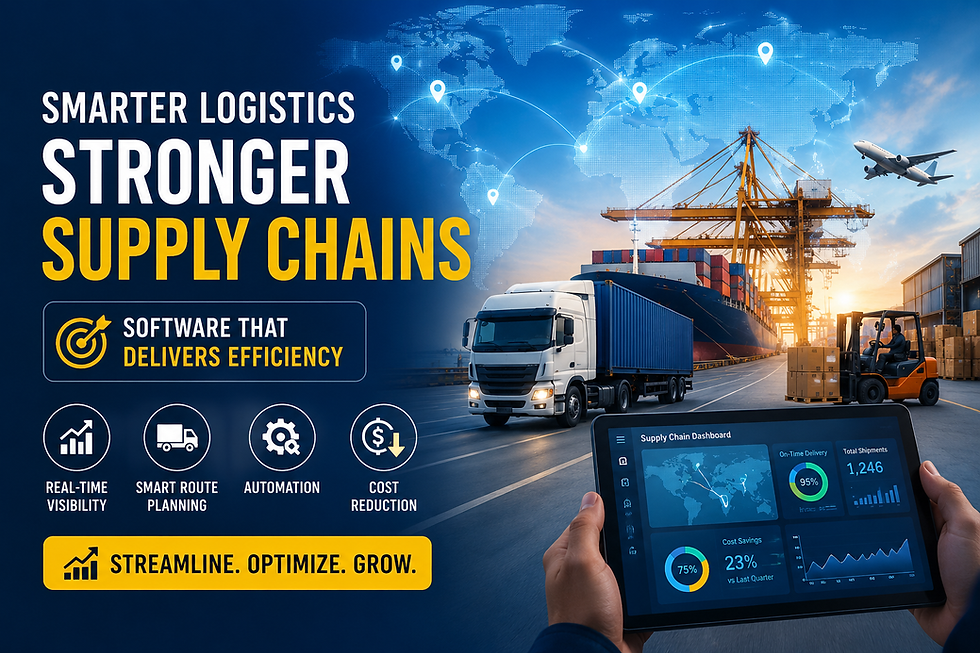
The logistics industry is at an inflection point. Shippers and third-party logistics providers (3PLs) face unprecedented pressure to cut costs, improve delivery speeds, and provide real-time visibility. A logistics software development company that builds custom software can unlock competitive advantages that off-the-shelf systems cannot match. Whether you need a transportation management system (TMS), a warehouse management system (WMS), a last-mile delivery platform, or a supply chain visibility solution, the right logistics software development company will tailor the technology to your exact operational requirements.
At iQlance, we've built hundreds of custom logistics applications for startups, mid-market shippers, and Fortune 500 enterprises.
What Is Logistics Software and Why It Matters Now
Logistics software is the backbone of modern supply chains. It manages the movement, storage, and delivery of goods from manufacturer to end customer. Unlike traditional logistics (which relied on manual tracking, phone calls, and spreadsheets), digital logistics platforms automate every touchpoint, from warehouse receiving through final-mile delivery.
According to Grand View Research, the global logistics software market was valued at $8.5 billion in 2023 and is projected to grow at a compound annual growth rate (CAGR) of 11.2% through 2030. This growth reflects the urgent need for supply chain visibility, automation, and AI-driven optimization across industries. Logistics software helps businesses:
Reduce operational costs by 15-25% through automation and data-driven decision-making. Accelerate delivery times by 20-30% with route optimization and predictive algorithms.
Improve customer satisfaction with real-time tracking and proactive exception management. Achieve regulatory compliance across multi-jurisdictional shipments. Scale globally without proportional headcount increases.
Key Ways Logistics Software Improves Supply Chain Efficiency
Modern logistics platforms drive efficiency across five core operational areas. The table below summarizes the business impact of each:
Logistics Software Benefit | Business Impact |
Real-Time Supply Chain Visibility | Eliminate blind spots. Track shipments from warehouse to doorstep with GPS precision and instant alerts. |
Automated Route Optimization | Reduce fuel costs by 15-20% through AI-powered routing. Faster deliveries, lower carbon footprint. |
Warehouse Management Automation | Cut order fulfillment time in half. Reduce manual errors and labor costs through intelligent task sequencing. |
Last-Mile Delivery Optimization | Improve on-time delivery rates to 98%+. Dynamic driver assignment and real-time traffic rerouting. |
Freight Cost Visibility | Negotiate better rates with carriers. Spot cost anomalies and eliminate hidden charges with transparent freight analytics. |
Inventory Sync Across Channels | Prevent overselling and stockouts. Real-time inventory visibility across all warehouses and sales channels. |
Each benefit compounds. When you combine real-time visibility with automated routing and intelligent resource allocation, you don't just save money on individual shipments. You free up strategic time for operations leaders to focus on growth and customer service innovation rather than firefighting operational bottlenecks.
Core Features of High-Impact Logistics Platforms
Not all logistics software is created equal. Enterprise-grade platforms should include these eight critical features of logistics software development:
Core Feature | What It Does |
Transportation Management System (TMS) | Centralize freight movement. Automate carrier selection, booking, tracking, and billing for multimodal shipments. |
Warehouse Management System (WMS) | Optimize inbound receipts, put-away, picking, packing, and outbound shipping. Cut fulfillment time by 30-40%. |
Route Optimization Engine | Maximize stops per route. Minimize distance and delivery windows through machine learning algorithms. |
Real-Time Shipment Tracking | Provide end-to-end visibility with GPS, geofencing, and proof-of-delivery. Reduce customer inquiries by 25%. |
Freight Analytics Dashboard | Track KPIs: cost per unit, carbon emissions, delivery on-time rates, carrier performance, and ROI. |
Last-Mile Delivery Module | Dynamic scheduling, driver mobile app, customer notifications, and contactless delivery options. |
Supply Chain Analytics | Predictive insights on demand, inventory levels, and procurement timing. Reduce stock outs by 35%. |
API Integration Framework | Seamlessly connect to ERP, accounting, CRM, and ecommerce platforms without custom development. |
Logistics Software Use Cases by Business Size
The best logistics software solution depends on your business stage and operational complexity. Here's how different organizations benefit:
Business Size | Key Challenge | Why Custom Software Wins |
Startups | Limited budget and need rapid scaling without off-the-shelf bloat. | Build lean MVP first. Add features as revenue grows. Pay only for what you use. |
SMEs | Growth pains from spreadsheets and disconnected systems. Scaling requires automation. | Unified platform that mirrors your current workflow. Gradual transition reduces disruption. |
Enterprise | Legacy systems limit agility. Need enterprise-grade integration and compliance. | Modular architecture supports legacy integration. Advanced analytics and AI-driven optimization. |
Regardless of size, your logistics software partner should approach your project strategically. Early-stage conversations should focus on your current pain points, growth targets, and regulatory constraints, not on fitting you into a pre-built mold.
Common Questions About Logistics Software Development
What is the cost of developing logistics software?
Cost varies widely based on scope and complexity. A basic MVP (minimum viable product) for a small 3PL might run $40,000-$80,000 and take 3-4 months. A full-featured TMS for mid-market operations ranges from $150,000-$400,000 over 6-9 months. Enterprise platforms with multi-tenant architecture, advanced analytics, and AI-driven optimization can exceed $1M over 12-18 months. The real question isn't the cost of development, it's the ROI. Most logistics platforms pay for themselves within 18-24 months through cost reduction and revenue uplift.
How long does it take to build a logistics software?
Timeline depends on feature scope and team structure. A focused MVP can ship in 8-12 weeks. Full-featured platforms typically require 6-12 months for the first production release. Ongoing enhancements and optimization continue indefinitely as you scale. The best logistics software development partners break projects into two-week sprints, so you see working software every 14 days and can adjust scope based on real user feedback, not guesses.
What should I look for in a logistics software development partner?
Look for five things: (1) Direct experience building transportation, warehousing, or 3PL systems. Ask for case studies and references. (2) Understanding of supply chain domain knowledge (TMS, WMS, last-mile mechanics), not just technical chops. (3) Agile methodology so you see working software frequently and can pivot based on user feedback. (4) Post-launch support and maintenance included, not as an afterthought. (5) API integration experience, because your logistics software must connect to ERP, accounting, and ecommerce platforms.
Can I use off-the-shelf logistics software instead of custom development?
Off-the-shelf platforms like SAP, Oracle NetSuite, Blue Yonder, and Descartes work for standardized workflows. But if you have unique business processes, specific compliance requirements, or need to differentiate your customer experience, you'll hit the limits of generic software. Custom development lets you build exactly what your business needs, then evolve the platform as your strategy changes. Many companies start with an off-the-shelf platform, hit constraints at scale, and rebuild with custom software.
What about AI and machine learning in logistics software?
AI-driven optimization is now table stakes. Modern logistics platforms use machine learning for demand forecasting, route optimization, carrier benchmarking, demand-driven supply planning, and anomaly detection. The technical barrier to entry has dropped significantly. The real opportunity is in how you apply ML to your specific business problem. A logistics software architect should ask: "Where will ML create the biggest ROI?" Typically the answer is route optimization, demand forecasting, or predictive maintenance.
How to Choose the Right Logistics Software Development Partner
The vendor selection process matters. A poor choice locks you into a multi-year relationship with a platform that doesn't fit. Here's a structured approach:
1. Define Your Operational Requirements: Before contacting vendors, document your current processes, pain points, growth targets, and non-negotiable features. This document becomes your evaluation rubric.
2. Assess Domain Expertise: Ask detailed questions about the vendor's experience with your industry (manufacturing 3PL, parcel, freight, etc.). Request case studies showing comparable complexity.
3. Evaluate Technical Architecture: Does the platform support multi-tenant deployments? Can it handle your transaction volume? Does it integrate cleanly with your existing stack?
4. Test the Development Process: Request a brief technical discovery session. A world-class partner will ask hard questions about your business before proposing solutions. Red flag: vendors who give you a quote in the first call.
5. Check References and Support: Talk directly to customers who've deployed similar solutions. Ask them about post-launch support, bug fix SLAs, and feature roadmap influence.
6. Negotiate Flexible Terms: Avoid long-term fixed-price contracts. Insist on milestone-based payments and the right to adjust scope based on learning.
Implementation Best Practices and Common Pitfalls
Even the best logistics software fails if implementation is rushed. Here's what separates successful deployments from costly disasters:
Best Practices
Start with a pilot: Roll out the system to a single warehouse or region first. Use real data and real users to validate assumptions before full deployment.
Invest in change management: Your users will resist change. Allocate 15-20% of the project budget to training, documentation, and change communications.
Establish data governance: Garbage in, garbage out. Before launch, audit and cleanse your historical data. Define master data standards.
Build integration bridges incrementally: Don't try to integrate all systems simultaneously. Start with the highest-impact connection (e.g., order management to warehouse), then expand.
Freeze scope at the waterline: Agree on MVP features upfront. Treat all other requests as post-launch enhancements to avoid scope creep.
Common Pitfalls to Avoid
Underestimating data migration: Moving seven years of warehouse transactions, shipment history, and customer records is harder than you think. Allocate double the time you think you need.
Ignoring user adoption metrics: Track adoption (daily active users, features used, system utilization rate) from week one. Low adoption often signals missing training, poor UX, or features that don't match user workflows.
Failing to plan for parallel run: Keep your legacy system running in parallel for 30-60 days post-launch. Reconcile transactions between old and new. This buffer prevents catastrophic losses from system failures.
Skipping post-launch optimization: The first 90 days post-launch are when you learn what's not working. Budget for optimization sprints that address real user pain points, not the vendor's product roadmap.
Future Trends in Logistics Software and Supply Chain Technology
The logistics technology landscape is evolving rapidly. Here are the trends in logistics software and supply chain shaping the next generation of software:
Autonomous and robotics integration: Warehouse automation and autonomous vehicles are moving from labs to production. Your logistics platform should abstract away the complexity of integrating heterogeneous robots.
Blockchain for supply chain transparency: Blockchain enables immutable tracking across multi-party supply chains, especially valuable for pharmaceuticals, food safety, and luxury goods verification.
Real-time IoT data streams: Sensors on shipments, pallets, and vehicles generate massive amounts of data. Next-gen platforms will process IoT data in real time to optimize in-transit decisions.
Generative AI for predictive supply planning: AI models will forecast demand, optimize safety stock levels, and recommend procurement timing with higher accuracy than traditional forecasting methods.
Hyperlocal last-mile networks: Micro-fulfillment centers and dynamic delivery networks will require software that handles thousands of daily decision points.
Carbon tracking and ESG reporting: Regulatory pressure on emissions will make carbon tracking and sustainability reporting non-negotiable features in logistics platforms.
Frequently Asked Questions
Should I build or buy logistics software?
The classic build-vs-buy decision. Buy if you have standardized operations that align with off-the-shelf platforms and strong vendor support. Build if you need proprietary competitive advantage, have unique workflows, or operate in a niche vertical where generic solutions under-deliver.
What is the difference between a TMS and a WMS?
A Transportation Management System (TMS) optimizes the movement of goods across the supply network. A Warehouse Management System (WMS) optimizes operations within the warehouse (receiving, put-away, picking, packing, shipping). Most businesses need both integrated, not siloed.
How do I measure the ROI of logistics software?
Track these metrics pre- and post-launch: cost per unit shipped, on-time delivery rate, warehouse labor productivity, carrier cost per shipment, customer inquiry rate, and order-to-delivery time. Most customers see 15-30% cost reduction and 20-40% speed improvement within 12 months.
Is cloud-based or on-premise logistics software better?
Cloud is increasingly the standard for new deployments. It offers lower upfront costs, automatic updates, and easier integrations. On-premise is only justified if you have extreme data residency requirements or legacy system constraints. Most enterprises now hybrid-deploy, with core operations in cloud and sensitive systems on-premise.
How do I ensure my logistics software vendor stays in business?
Evaluate vendor stability by reviewing funding history, customer base size, customer churn rate, and roadmap transparency. Prefer established vendors with 50+ customers and proven SaaS metrics. For custom development partners, ensure they provide source code escrow and transition support in the event of an acquisition or dissolution.


Comments